Recognise what does not fit.
Learn to notice changes in breathing, responsiveness, colour, circulation, behaviour and trajectory — and ask whether “part of the process” is still a safe explanation.

Helping non-clinical teams recognise deterioration, respond effectively and escalate before delay changes the outcome.
First aid built for the environment you actually work in.
Not generic workplace first aid. FieldSafe training is shaped around the risks, behaviours and decision-making challenges that can arise around retreats, ceremony, fasting, heat, breathwork, altered states, festivals and remote venues.
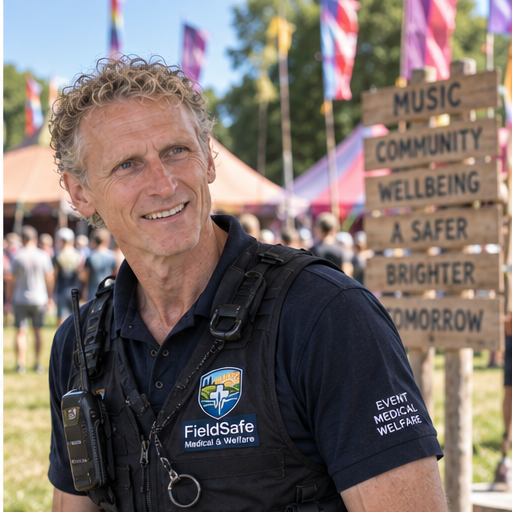
Standard first-aid skills still matter. FieldSafe adds the context-specific judgement retreat and event teams need when illness can be mistaken for the expected effects of ceremony, exertion, heat, fasting, purging or an altered state.
Learn to notice changes in breathing, responsiveness, colour, circulation, behaviour and trajectory — and ask whether “part of the process” is still a safe explanation.
Work through situations such as altered consciousness, hypoglycaemia, seizures, anaphylaxis, heat illness, dehydration, vomiting and medical deterioration without trying to make a lay diagnosis.
Practise first actions, role allocation, 999 communication, reassessment, ambulance access and handover so the people already responsible for the setting can work calmly together.
You do not need to understand the whole FieldSafe offer before you know where to begin. Pick the responsibility that feels closest to yours.
You need people who can tell the difference between an expected altered state and somebody becoming medically unwell.
See Retreat Response →You need a calm first response, clear escalation and a team that knows what to do before professional help arrives.
Compare training →You need the people, access, kit, communications and emergency plan to work together when time matters.
Review venue readiness →You want the important information you choose to be available if you cannot explain it yourself.
See FieldSafe SOS →If you are still not sure: tell me the setting and what worries you. If FieldSafe is not the right fit, I will say so.
Understand the setting. Prepare the team. Practise the response. Act when something changes. Review what the incident taught you.
The free FieldSafe Readiness Check asks ten practical questions about people, access, kit, communication and rehearsal. No email gate. No score pretending to be accreditation. Just a quick way to see where the gaps are.
Take the 2-minute readiness checkThose questions are simple enough to remember and useful enough to change a decision.
FieldSafe helps organisers turn a vague concern — “what happens if something goes wrong?” — into something that has been thought through: who takes responsibility, how the team responds, what gets escalated and what happens next.
Clear roles, escalation and communication mean responsibility does not become everybody’s job and nobody’s job when pressure rises.
People, access, kit, communications and emergency services have to work together in the venue you actually have — not the one imagined on paper.
The aim is not a promise that nothing will go wrong. It is the confidence that this area of responsibility has been prepared, allocated and made usable.
FieldSafe is built for people responsible for others in retreats, festivals, events and remote settings. The practical offer includes first-aid training, response leadership, venue readiness and personal emergency information; the outcome is simpler: this part of the responsibility has been properly thought through.
A private personal emergency record with a separate Emergency View you control. Digital only. £9 once.
Discover FieldSafe SOS →Practical, scenario-based emergency-response training for retreat teams, facilitators, wellness centres and remote venues.
Explore training →Venue access, communications, first-aid equipment, AED readiness and written emergency planning around the people.
Explore readiness →Every course starts with the same practical question: could this be something else? The training then builds the observations, first actions, reassessment and escalation skills your team needs in retreat, festival and remote environments.
Best for smaller retreat teams needing a practical emergency foundation.
Best for established teams wanting deeper judgement, retreat-sensitive scenarios and repeated reassessment.
Best for core retreat teams who need to lead the response and make the system around them work.
Best for teams that have already completed FieldSafe practical training and want a structured yearly refresh.
Fasting, heat, breathwork, ceremony, purging, altered state and exhaustion can all provide an easy explanation for somebody who looks unwell. FieldSafe teaches teams to notice what does not fit, use simple observations and recognise when watching and waiting is becoming unsafe.
The aim is not lay diagnosis. It is earlier recognition and better escalation.
FieldSafe stories are not rescue stories. They show the decisions, observations and changes in trajectory that matter when the textbook presentation is missing.
An emergency that did not begin like the textbook — and why observing what changed mattered more than forcing an early label.
A person can appear relatively stable at one moment while the direction of travel is anything but reassuring.
The first treatment was given. The emergency was not over. Reassessment and preparation for deterioration remained essential.
A capable team can still lose critical minutes if the ambulance cannot find the site, nobody knows where the AED is, communications fail or essential equipment is locked away.
Give individuals a private emergency-information record and a responder-facing Emergency View they control — useful when the person cannot explain their own history clearly.
Build the core response team and the system around them — leadership, role allocation, access, communications, equipment, rehearsal and a written readiness plan.
Make the AED part of a working response rather than an object on a wall: decide whether it is needed, where it lives, who checks it and how quickly it can reach a casualty.
FieldSafe SOS gives you a private emergency-information record and a separate responder-facing Emergency View. You choose what appears in that view. Everything else stays private behind your account.

Keep your private record separate from the Emergency View you choose to share.
Explore the phone demo. Swipe on touchscreens, click-and-drag on desktop, or use the arrows and keyboard. Emergency Mode is optional and off by default.

FieldSafe brings together decades of high-acuity emergency experience, advanced resuscitation teaching, senior event leadership and long familiarity with retreat environments — then translates that depth into practical judgement for non-clinical teams.
Earlier in my career I was selected into advanced resuscitation instructor training not only for technical performance, but for how I communicated, supported other candidates and worked within the team. Years later, on a separate course, that same behaviour was independently recognised again while I was helping candidates who were struggling.
In high-stakes environments, expertise is not demonstrated by being the loudest person in the room. Strong teams are built so everybody feels able to speak, contribute and act.
Clear scope builds confidence. FieldSafe specialist training sits alongside any formal workplace first-aid requirements your organisation has.
No. These retreat programmes are specialist FieldSafe emergency-response training for lay teams. They are not represented as EFAW or FAW unless a separately recognised pathway is explicitly stated.
Yes. The language and scenarios are designed for non-clinical staff, facilitators, volunteers and venue teams.
Yes on face-to-face courses. Practical sessions are built around doing, not merely watching demonstrations.
No. Travel, parking, tolls and any necessary accommodation are quoted separately and agreed before booking.
Stories from real incidents, practical frameworks, occasional letters and tools for people who carry responsibility. It is a library, not a content treadmill.
You do not need to know everything. You do need to notice when the story no longer makes sense, organise the people around you and ask for help early enough.
Read the letter →Share the setting, team size and the situations you most want your people to feel prepared for. FieldSafe will recommend the most appropriate format and provide a clear quotation.